Vaping in Ontario is regulated by two levels of government. Federal law, mainly the Tobacco and Vaping Products Act and its regulations, controls what vaping products can contain, how they are packaged and how they can be promoted. Provincial law, the Smoke-Free Ontario Act, 2017, controls who can buy them, where they can be sold and where they can be used. Together, those rules shape almost everything about how you shop for vapes in Scarborough, from the ID check at the counter to how little you can see on a vape shop’s website.
This post is a plain summary of the rules as they stand in 2026. It is not legal advice and it does not cover every detail, but it explains the parts that matter most when you walk into a store or look one up online.
You must be 19 to buy vaping products in Ontario
The minimum legal age to buy vaping products in Ontario is 19. That applies to every category: devices, e-liquids, disposable vapes, pods, coils and accessories sold for vaping. It applies whether you buy in a store or arrange local delivery, and delivery orders require photo ID at handoff just as an in-store purchase does at the counter.
Retailers are required to verify age, and the standard practice in Ontario is to ask for photo ID from anyone who appears to be under 25. Acceptable ID is government issued photo identification showing your birth date, such as a driver’s licence, an Ontario photo card or a passport. Selling to someone underage is a ticketable offence for the retailer, so a store that asks for your ID every visit is doing exactly what the law expects.
Nicotine is capped at 20 mg/mL across Canada
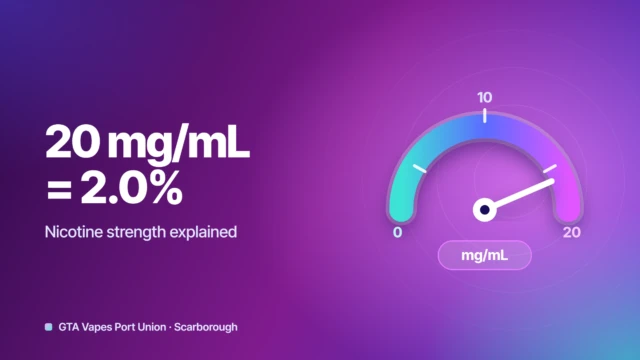
Since 2021, federal regulations have capped the nicotine concentration of vaping products sold in Canada at 20 mg per millilitre. The cap applies to everything on a Canadian shelf: bottled e-liquid, prefilled pods and disposable vapes alike.
In practice, this means the strongest salt nicotine product you will find in a legal Ontario store is 20 mg/mL. A product labelled above that strength is not a legal Canadian product, so listings for 50 mg disposables come from outside the regulated market. Canadian retailers stock strengths from 0 up to the 20 mg/mL maximum, and labels must state the concentration.
Where vaping products can legally be sold
Ontario draws a clear line between general retailers, such as convenience stores and gas stations, and specialty vape stores. A specialty vape store is a shop that primarily sells vaping products, restricts entry to customers 19 and over, and is registered with its local public health unit.
The distinction matters because each type of store is allowed to do different things. A general retailer must keep vaping products out of sight and cannot let you examine a product before you buy it. A registered specialty vape store can display products openly inside the shop, let adult customers view and compare them, and answer product questions face to face. That is why the shelves inside a specialty store look nothing like the hidden cabinet behind a convenience store counter.
Flavours beyond tobacco, mint and menthol are specialty-store-only
Ontario also restricts which e-liquid flavours can be sold outside specialty vape stores. Convenience stores and other general retailers are limited to tobacco, mint and menthol flavours. The wider range, including fruit flavours, can only be sold in registered specialty vape stores, where everyone who walks in has already been age-verified at the door. If you have ever wondered why a gas station carries so few options, that is the rule behind it.
Why vape shop websites show so little
If you have browsed a vape shop’s website and found age gates, short product pages and limited detail, that is not the store being unhelpful. Federal promotion rules restrict how vaping products can be advertised anywhere young persons could see the material, and the open web counts. Lifestyle advertising is prohibited outright, and many kinds of product promotion are only permitted in places that adults alone can access.
Because violations are enforceable offences, most Ontario vape retailers keep their public websites minimal and place an age gate in front of anything product related. Detailed browsing is meant to happen inside the store, where the 19+ rule is enforced in person rather than by a checkbox.
Other rules worth knowing
Federal labelling rules require child-resistant packaging, a stated nicotine concentration and required warnings on vaping products. The Smoke-Free Ontario Act also restricts where vaping is allowed: enclosed workplaces, enclosed public places, school grounds, restaurant and bar patios and a range of other designated spaces are off limits. Municipalities can add their own restrictions on top, so signage is worth reading.
What this means when you shop in Scarborough
Practically, the rules shape a routine that looks like this. Bring photo ID every time, even at a store that has served you for years. Expect to browse in person rather than online, because a specialty store’s shelves can legally show you far more than its website. If you are after a specific device, flavour or strength, call ahead, since staff can confirm what is in stock over the phone even when they cannot list it all publicly. And if you want flavours beyond tobacco, mint and menthol, a registered specialty vape store is the only kind of shop in Ontario that can sell them to you.
How GTA Vapes Port Union operates under these rules
GTA Vapes Port Union is a specialty vape shop at 91 Rylander Blvd in the Port Union area of east Scarborough, and everything above describes how we run day to day. The store is 19+, we check photo ID for anyone who appears under 25, and the disposable vapes and e-liquids we carry are displayed in store, where you can look at products up close and ask our staff questions before you buy. We are open until midnight Thursday to Saturday, so a later visit is easy. If you want to confirm we carry a specific brand or model before you come in, contact us at (416) 724-8237 and we will check the shelf for you.